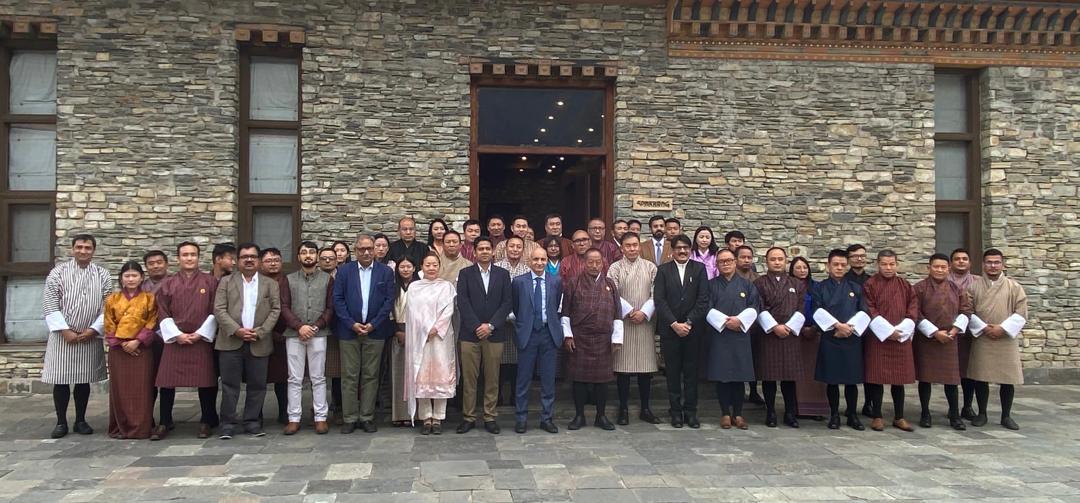
On October 29, 2025, the Department of Environment and Climate Change (DECC), Ministry of Energy and Natural Resources, in collaboration with the International Centre for Integrated Mountain Development (ICIMOD), organized the industry sector consultation in Thimphu for the development of Bhutan’s National Clean Air Action Plan (NCAAP). The concept of NCAAP was formally launched at an inception workshop on September 15, 2025, in Thimphu, bringing together diverse stakeholders to establish a shared goal of improving air quality across the country. The NCAAP is being jointly developed by DECC and ICIMOD.
The consultation was graced by His Excellency, the Hon’ble Minister, Ministry of Energy and Natural Resources, highlighting Bhutan’s leadership and commitment to ensuring clean air and safeguarding public health. The Guest of Honour, Mr. Vir Vikram Yadav, IAS, Additional Secretary, Ministry of Environment, Forest, and Climate Change, and Chairman of the Central Pollution Control Board, shared India’s experience of enabling policies and regulations for industrial air pollution control.
There were representatives from the Department of Industry, Bhutan Chamber of Commerce and Industry, Association of Bhutanese Industries, industry stakeholders, academia, as well as technical experts from The Energy and Resources Institute, India and ICIMOD. The consultation focused on exploring strategies for reducing industrial emissions and promoting cleaner, energy efficient production practices.
Key highlights of the consultation include:
Sharing insights on industrial air pollution control and best practices from regional experts.
Interactive discussions on pathways to low-emission and energy-efficient production in cement and ferroalloy industries.
Exploring dust management, energy use, and cleaner production techniques in small-scale manufacturing industries, including Fast Moving Consumer Goods (FMCG).
Understanding the social dimensions of air quality management in the industry sector.
This sector-specific consultation is a critical step towards providing a roadmap to reduce emissions, strengthen data-driven decision-making, and promote sustainable industrial technologies and practices while fostering industrial growth and ensuring public health.