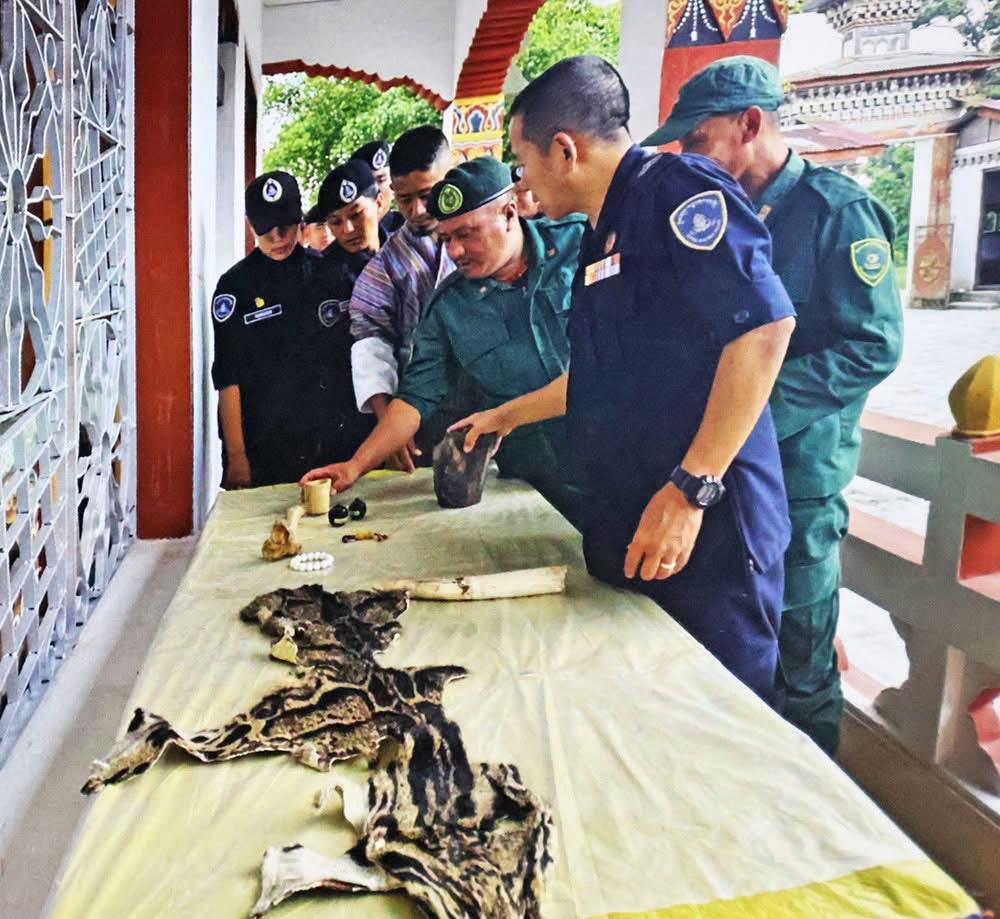
To address one of the world’s most lucrative and destructive criminal industries, the Department of Forests and Park Services (DoFPS) has launched the National Zero Poaching Strategy 2025-2029 to eliminate wildlife poaching and illegal trade within its borders.
This strategy, an evolution of the first initiative implemented from 2017 to 2021, represents a crucial pillar in our country’s ongoing efforts to protect the country’s rich biodiversity amid rising threats, both locally and globally.
Globally, the illegal wildlife trade is a multibillion-dollar black market, estimated to be worth between USD 7 billion and USD 23 billion annually. It ranks alongside drugs, arms, and human trafficking as one of the most profitable and dangerous illicit trades.
The industry, run by transnational criminal networks, targets thousands of species across over 160 countries, including elephants, tigers, rhinos, pangolins, and bears. The impact is not only ecological, risking extinction and ecosystem collapse, but also human, with park rangers losing their lives and communities increasingly caught between conservation efforts and survival.
Despite its relatively small size and protected landscapes, Bhutan is not immune from illegal wildlife trade.
Since 2016, the country has experienced a notable increase in poaching incidents and wildlife contraband seizures. Its strategic location bordering India and China, along with porous high-altitude routes and limited detection capacity at check posts, makes Bhutan both a source and a transit point for illegal wildlife trafficking.
Domestically, illegal trade in species such as musk deer, Asiatic black bears, and even protected flora like red sanders is growing, often driven by demand in traditional medicine and luxury markets.
Wildlife poaching has been detected in all districts ranging from one to 37 incidences per 25 square kilometres between 2020 and 2023. Smuggling is more prominent in Thimphu, Sarpang, Chukha, Haa, Paro, Mongar, Samdrupjongkhar, and Trashigang.
To implement the new strategy, DoFPS in coordination with the Royal Bhutan Policy, the Royal Bhutan Army, the judiciary, customs and immigration services, and international partners, has designed an approach that reflects the complexity of wildlife crime and responds with a unified, holistic effort.
Critical financial and technical support has come from WWF-Bhutan, the Bhutan for Life Project, and the US Department of State through the Countering Wildlife Trade Project.
The new National Wildlife Crime Control Committee established in 2023, will oversee interagency coordination and policy enforcement. This high-level body is expected to meet annually to review progress, address legal gaps, and adapt to emerging threats.
Additionally, over 1,200 technical staff, spread across Bhutan’s 14 divisional forest offices, 10 national parks, and nearly 100 range and beat offices, are central to frontline enforcement and surveillance.
The goal of the strategy is straightforward yet ambitious: to eliminate poaching and contribute to a global vision of a world free of wildlife crime. But how Bhutan plans to do this reflects deep lessons learned from the past. The new strategy is built on six strategic pillars that integrate advanced technology, legal reform, community engagement, and regional cooperation.
First, it calls for improved data gathering on poaching trends, using tools like SMART (Spatial Monitoring and Reporting Tool) patrolling, and geospatial analysis through FIRMS (Forest Information Reporting and Monitoring System). Despite a 27 percent increase is the national tiger population and international recognition of Bhutan’s tiger reserves through Conservation Assured Tiger Standards accreditation, enforcement gaps remain, particularly in wildlife trade hotspots such as Thimphu, Chukha, Sarpang, and Trashigang.
Second, Bhutan plans to expand the use of technology. Less than 10 percent of frontline enforcement units has access to modern surveillance tools in earlier years. The strategy now emphasises scaling up drones, sensor-triggered cameras systems like PoacherCams and TrailGuard, and better data integration between SMART and criminal intelligence platforms. Limited DNA forensics capacity also remains a critical bottleneck, with Bhutan currently relying on overseas labs.
Third, institutional capacity will be reinforced. While forest officers are empowered under the Forest and Nature Conservation Act 2023 to search, seize, and arrest without a warrant, weak legal training has often resulted in the loss of court cases. The new strategy emphasises legal education, development of species identification manuals, and dedicated wildlife crime training for investigators and prosecutors.
The fourth pillar focuses on community engagement. Given that only eight percent of Bhutan’s land is arable, rural livelihoods often depend on forest resources, increasing vulnerability to illegal trade. To address this, the strategy proposes strengthening local stewardship, providing alternative income sources such as ecotourism, and formalising community-based patrols. The informal network of informants will also be standardised, with structured incentive and information-sharing mechanisms.
Fifth, the strategy aims to improve legal proceedings and judicial outcomes. The 2023 Forest and Nature Conservation Act introduced stricter penalties, including fourth-degree felony charges (three to five years’ imprisonment) for poaching Schedule I species.
However, gaps remain, particularly regarding the treatment of Convention on International Trade in Endangered Species of Wild Fauna and Flora- listed species not yet fully integrated into domestic law. Judicial training and the sensitisation of prosecutors and judges are key recommendations moving forward.
The strategy also emphasises regional and international cooperation. Bhutan is an active member of platforms such as the South Asia Wildlife Enforcement Network and the Strengthening Regional Cooperation for Wildlife Protection in Asia. It also collaborates with global enforcement and policy institutions including INTERPOL, the International Consortium on combating Wildlife Crime, and the United Nations Office on Drugs and Crime. Cross-border intelligence sharing and legal harmonisation are seen as essential to tackling networks that span multiple countries and continents.
The National Zero Poaching Strategy aligns with Bhutan’s broader conservation goals, enshrined in its constitution and inspired by the philosophy of Gross National Happiness.
With over 69 percent forest cover, Bhutan remains carbon-negative, absorbing more carbon dioxide that it emits, a rare status globally.
As a biodiversity hotspot in the Eastern Himalayas, Bhutan is home to over 5,600 species of plants, more than 200 species of mammals, and nearly 750 species of birds, including several globally endangered.
DoFPS Launches Zero Poaching Strategy to end Wildlife Crime