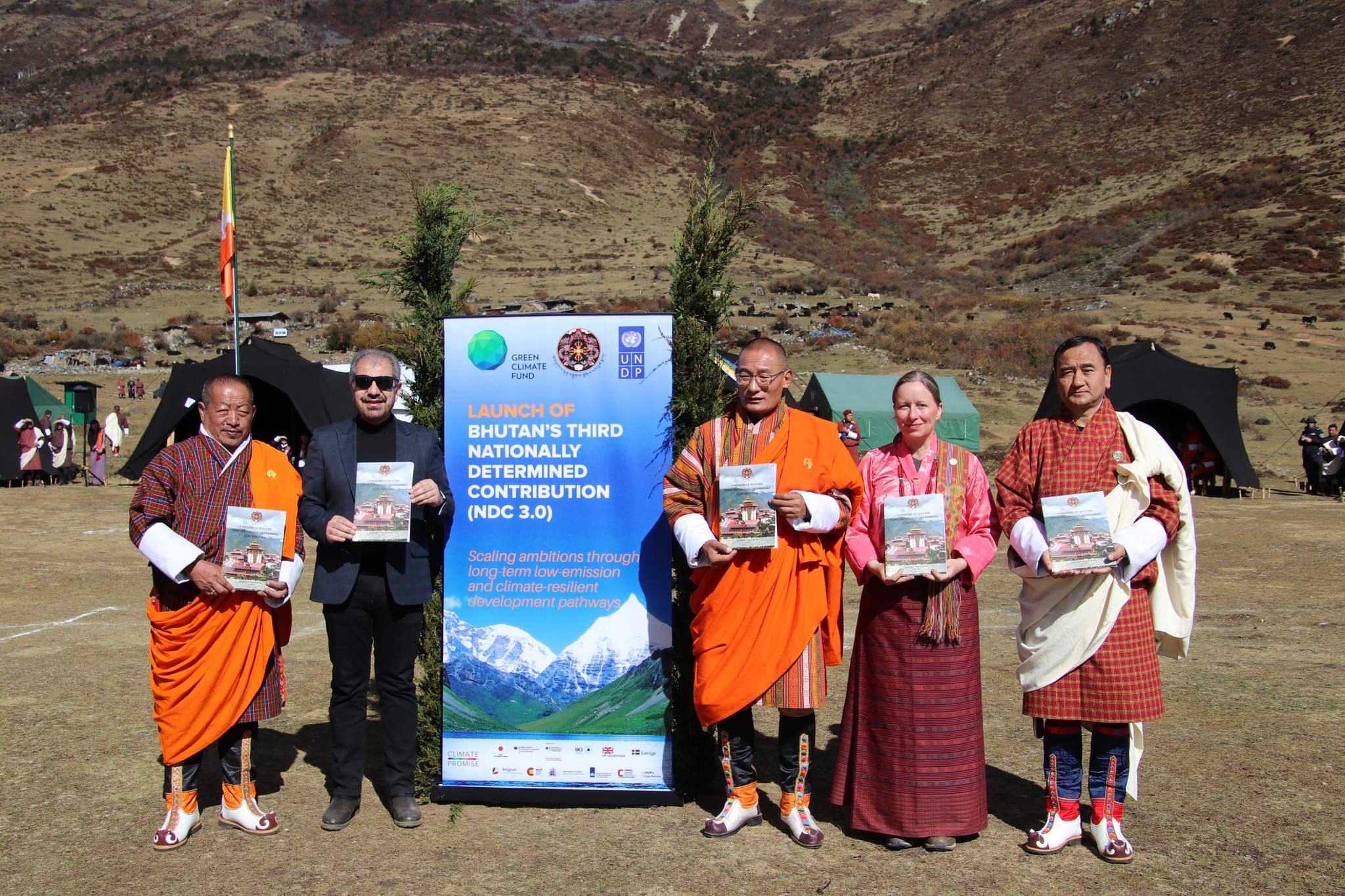
Royal Highland Festival, Laya – October 24, 2025
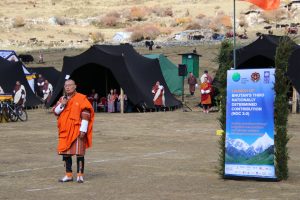
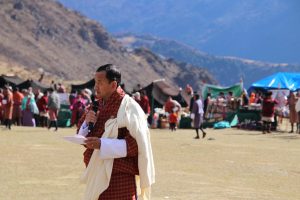
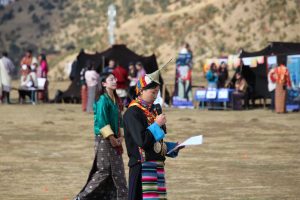
The Hon’ble Prime Minister, Dasho Tshering Tobgay, in collaboration with MoENR and UNDP Bhutan, unveiled Bhutan’s Third Nationally Determined Contribution (NDC 3.0) during the 8th Royal Highland Festival in the presence of government officials, the people of Laya, UNICEF, Embassy of Germany, international guests, and agencies. The unveiling reaffirmed Bhutan’s unwavering commitment to environmental stewardship and global climate action. As a small, landlocked, mountainous developing nation that has not contributed to the global climate crisis, Bhutan continues to lead by example, pledging to remain carbon neutral for all time and strengthening its ambition to build a resilient, inclusive, and sustainable future.
In its Third NDC, covering the period up to 2035, Bhutan reaffirms its historic 2009 commitment to ensure that greenhouse gas (GHG) emissions do not exceed the carbon sequestration capacity of its forests and land-based sinks. This economy-wide target represents a significant progression from previous NDCs, integrating emission projections, mitigation potentials, and adaptation priorities across all sectors. Despite graduating from Least Developed Country status in 2023, Bhutan continues to face acute vulnerabilities from climate change, including rising temperatures, erratic rainfall, glacial lake outburst floods, landslides, and forest fires – threats that endanger livelihoods, ecosystems, and cultural heritage in this fragile Himalayan environment.
“Only a few nations can say that our forests absorb six times more carbon than we emit,” said Prime Minister Dasho Tshering Tobgay. “For Bhutan, remaining carbon neutral is not a slogan. It is a deliberate, costly, and moral choice, one that reflects our conviction. We stretch our limited budgets to build climate resilience, and we see it not as a burden, but a responsibility to future generations.”
Key highlights of Bhutan’s Third NDC include:
Economy-Wide Mitigation Ambition: Building on the updated Long-Term Low Greenhouse Gas Emission and Climate-Resilient Development Strategy (LTS 2025), Bhutan projects maintaining carbon neutrality through 2035 under a business-as-usual scenario, with potential for deeper reductions through interventions in energy, industry, agriculture, forestry, and waste. This includes expanding renewable energy to 25,000 MW by 2040, promoting electric vehicles, energy efficiency, and circular economy practices. The NDC also incorporates short-lived climate pollutants (SLCPs) through initiatives like the National SLCP Plan and Methane Roadmap, aligning with global calls to reduce non-CO₂ emissions.
Comprehensive Adaptation Priorities: Informed by Bhutan’s First National Adaptation Plan (NAP), the NDC emphasizes resilience in seven key sectors, including water, agriculture, health, and biodiversity. Estimated at US$14 billion over 2023-2038, adaptation efforts focus on protecting vulnerable ecosystems and communities from extreme weather and slow-onset changes, with synergies between mitigation and adaptation—such as sustainable forest management that enhances carbon sinks while bolstering water security.
In addition to strengthening traditional mitigation sectors such as energy, transport, industry, agriculture, livestock, human settlements and forestry, the Third NDC emphasizes climate adaptation as an urgent priority. It highlights the need to safeguard Bhutan’s mountain ecosystems, water and energy security, food systems, health, and infrastructure in the face of changing climatic conditions. And build resilience to the impacts of climate change by enhancing climate services.
Inclusivity and Social Integration: The NDC process involved extensive consultations with government, private sector, civil society, youth, children, and vulnerable groups, ensuring gender-responsive and inclusive actions. Social sectors are prioritized, with a focus on engaging children and youth in climate education and decision-making, alongside protections for the elderly, persons with disabilities, and women. This aligns with Bhutan’s Gross National Happiness philosophy, embedding climate action in national development plans like the 13th Five-Year Plan and the 10X National Economic Vision 2050.
Incorporation of Loss and Damage Considerations: For the first time, Bhutan’s NDC explicitly addresses loss and damage from climate impacts that outpace adaptation efforts, including economic and non-economic losses from floods, GLOFs, landslides, forest fires, and slow-onset events like glacier melt and droughts. As a highly vulnerable country, Bhutan calls for international solidarity, including access to the Fund for Responding to Loss and Damage (FRLD) and technical assistance from the Santiago Network for Loss and Damage (SNLD), to build institutional capacity, create a centralized database for tracking losses, and support recovery and rehabilitation.
Means of Implementation: Bhutan outlines a robust framework for realizing its NDC goals, combining domestic resources with international support. Key mechanisms include the Green Finance Taxonomy to direct investments toward sustainable activities, the Bhutan Climate Fund to mobilize and channel carbon finance into low-carbon projects and enhanced direct access to UNFCCC funds through accredited entities like the Bhutan Trust Fund for Environmental Conservation. Notably, Bhutan is advancing voluntary cooperation under Article 6 of the Paris Agreement through carbon markets, with established tools such as the Bhutan Carbon Market Rules (2023), National Carbon Registry, Carbon Markets Policy (2025), and a Positive List of eligible activities. These enable high-integrity carbon trading to finance mitigation and adaptation, bridging domestic investments with global climate finance.
Call for International Support: While Bhutan exceeds its fair share in global climate efforts, sustaining carbon neutrality and addressing loss and damage depends on international cooperation. The NDC highlights the need for finance, technology, and capacity-building to counter climate threats. Initiatives such as the Bhutan Climate Fund, Green Finance Taxonomy, and participation in carbon markets aim to mobilize resources but are contingent on adequate global support.
Bhutan’s Third NDC responds to the First Global Stocktake outcomes, advancing renewable energy tripling, improving energy efficiency, and fossil fuel transitions. Through visionary projects like the Gelephu Mindfulness City—a carbon-negative economic hub—the country demonstrates how innovation, mindfulness, and sustainability can drive prosperity without compromising the planet.
As Bhutan charts its path to a tenfold GDP growth by 2050, this Third NDC reaffirms that environmental leadership is integral to national progress. The NDC will be presented to the UNFCCC Secretariat prior to COP 30 in Belem, Brazil, next month.
For media inquiries, contact:
Ms. Tshering Sonam Wangmo
Policy and Planning Division, MoENR
Email: tswangmo@moenr.gov.bt
Ms. Lekzang Jayoed Dorji
Climate Change Division
Department of Environment and Climate Change, MoENR
Email: ljdorji@moenr.gov.bt
Ms. Dechen Wangmo
Communications Lead
UNDP, Thimphu
Email: dechen.wangmo@undp.org