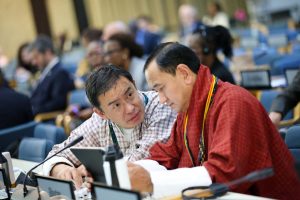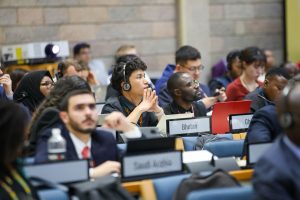
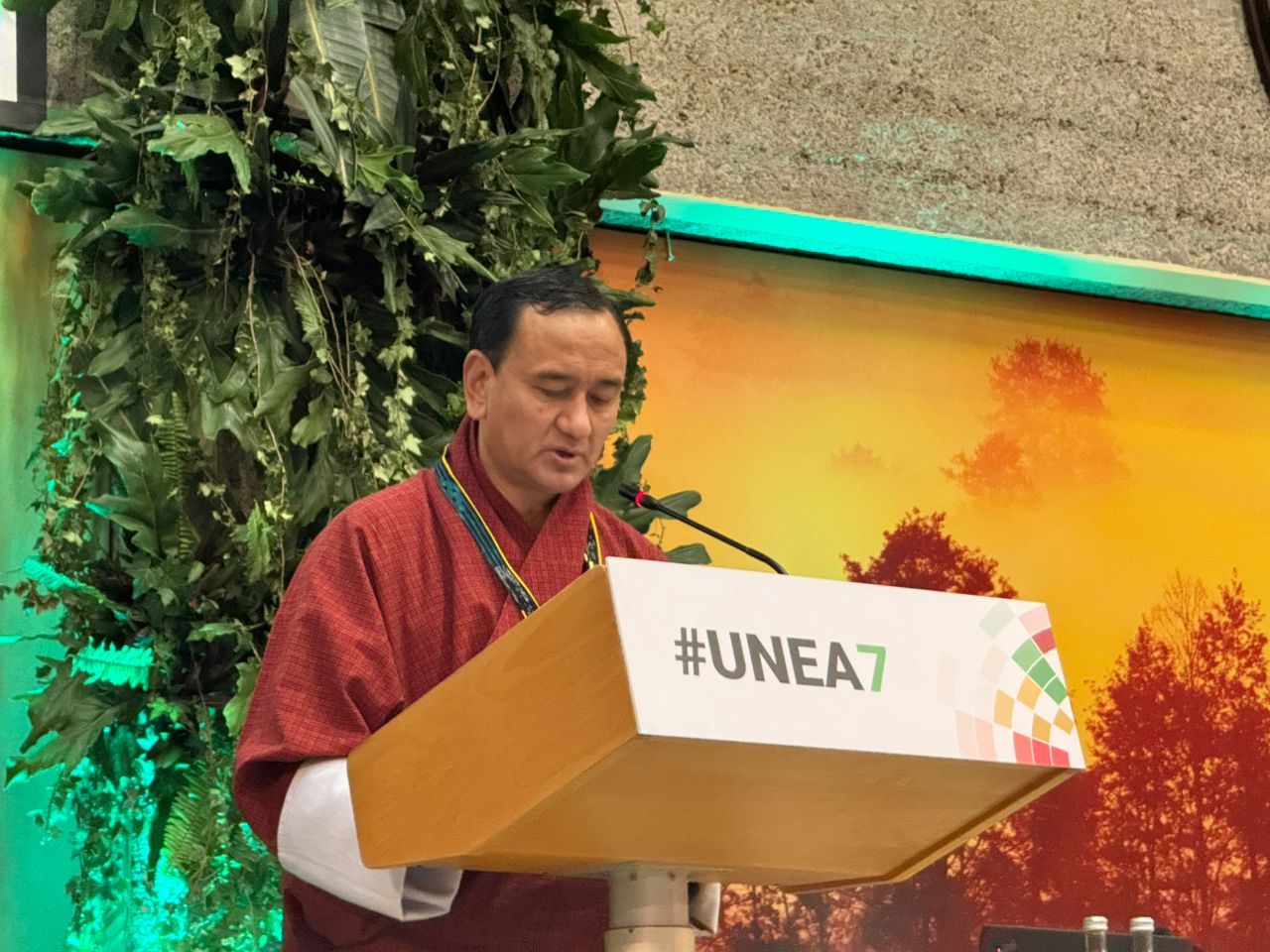
Bhutan participated at the Seventh Session of United Nations Environment Assembly (UNEA-7), the world’s highest-level decision-making body on environment. Established in 2012 as an outcome of the Rio+20 Conference, UNEA convenes biennially at the United Nations Environment Programme headquarters in Nairobi and sets global environmental priorities and strengthen international environmental law. The session, held from 8–12 December 2025 in Nairobi under the theme “Advancing sustainable solutions for a resilient planet”, was attended by thousands of participants from across the world and adopted resolutions, decisions and a ministerial declaration aimed at addressing the triple planetary crisis of climate change, biodiversity loss and pollution.
Bhutan’s delegation was led by Mr. Karma Tshering, Hon’ble Secretary of the Ministry of Energy & Natural Resources. At UNEA-7, Bhutan played an active role in negotiations and co-sponsored two landmark resolutions through the Ministry of Energy and Natural Resources and its Department of Environment and Climate Change.
Among these historic outcomes is Resolution UNEP/EA.7/L.15 on the “Preservation of Glaciers and the Broader Cryosphere, Particularly in Mountain Regions”, the first-ever dedicated UNEA resolution on mountains and the cryosphere. Co-sponsored by Bhutan together with Peru and Tajikistan, this resolution recognizes the vital importance of glacier- and snow dependent systems for water, food, energy security, ecosystems and cultures, and calls for enhanced international cooperation to safeguard mountain regions and downstream communities. For Bhutan, a landlocked mountain country whose agriculture, hydropower and communities depend heavily on glacier fed river systems, the adoption of this resolution marks a watershed moment for securing greater global attention to the Himalayas and other vulnerable mountain regions.
Furthermore, Bhutan co-sponsored Resolution UNEP/EA.7/L.9 on “Enhancing the Meaningful Participation of Youth in Environmental Processes and Environmental Education”, alongside Sri Lanka, Burkina Faso and Thailand. This resolution strengthens mechanisms for youth participation in environmental decision making, supports the Youth Environment Assembly as the principal youth platform under UNEA, and promotes environmental education and competencies for sustainable development. The outcome reflects Bhutan’s enduring commitment to empower young people as stewards and leaders of environmental governance at home and globally.
The resolutions affirm that mountain regions, home to critical freshwater sources, unique biodiversity, and vulnerable populations, must be central to global climate and environmental policies. They recognize the particular vulnerabilities of mountain communities to climate change and the need for targeted support and resources.
Bhutan’s pivotal role as co-sponsor of both resolutions emphasizes the nation’s continued leadership in international environmental stewardship and its dedication to advancing climate action, biodiversity conservation, and equitable environmental governance through the United Nations multilateral framework.